Right Triangle Trigonometry
7.2 Right Triangle Trigonometry
Right Triangles and the Pythagorean Theorem
Everything in right-triangle trig rests on one backbone relationship. Namely, Pythagoras' theorem $a^2+b^2=c^2$. Famously, there are many proofs of this theorem. It is a fundamental truth in mathematics that is discovered time and time again. What might not be well known is that a United States president discovered his own proof in 1876!
Theorem: Pythagorean Theorem
For a right triangle with legs $a,b$ and hypotenuse $c$:
$$ a^2+b^2=c^2 $$
Fact: Naming Convention
It is standard to label the hypotenuse, the longest side in a right triangle, as $c$. The legs are labeled $a$ and $b$. The angles opposite of them are labeled capital versions of those letters or sometimes their greek counterparts. The angle opposite of side $a$ is $A$ or $\alpha$ while the angle opposite of $b$ is $B$ or $\beta$.
Example: Find a missing hypotenuse
A right triangle has legs 3 and 4. Find the hypotenuse.
Show Solution
Use $$ a^2+b^2=c^2 $$
Substitute: $$ 3^2+4^2=c^2 $$
Compute: $$ 9+16=c^2 $$ $$ 25=c^2 $$
Take positive square root (lengths are positive): $$ c=5 $$
Example: Find a missing leg
A right triangle has hypotenuse 13 and one leg 12. Find the other leg.
Show Solution
Let unknown leg be $x$: $$ 12^2+x^2=13^2 $$
Compute squares: $$ 144+x^2=169 $$
Solve: $$ x^2=169-144=25 $$ $$ x=5 $$
MyOpenMath: Try your own!
Sine, Cosine, and Tangent (SOH-CAH-TOA)
Now that side lengths are in place, we can start talking about the trigonometric ratios. This is where trig starts acting like a function language. These functions take an angle and return a ratio of the sides of the triangle.
Definition: Sine, Cosine, and Tangent
For an acute angle $\theta$ in a right triangle:
$$ \sin(\theta)=\frac{\text{opposite}}{\text{hypotenuse}},\quad \cos(\theta)=\frac{\text{adjacent}}{\text{hypotenuse}},\quad \tan(\theta)=\frac{\text{opposite}}{\text{adjacent}} $$
Mnemonic: SOH-CAH-TOA.
Example: Compute sin, cos, tan from side lengths
In a right triangle, relative to angle $\theta$, opposite side is 3 and adjacent side is 4. Find $\sin(\theta),\cos(\theta),\tan(\theta)$.
Show Solution
First find hypotenuse: $$ c=\sqrt{3^2+4^2}=\sqrt{25}=5 $$
Now ratios: $$ \sin(\theta)=\frac{3}{5} $$ $$ \cos(\theta)=\frac{4}{5} $$ $$ \tan(\theta)=\frac{3}{4} $$
Example: Find trig ratios from a triangle
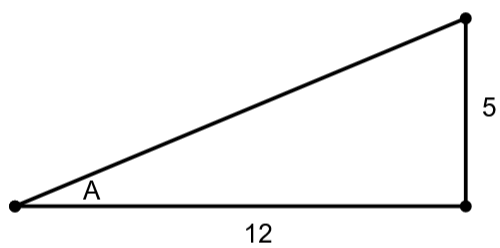
Find the sine, cosine, and tangent of $A$.
Show Solution
$$ \sin(A)=\frac{5}{13},\quad \cos(A)=\frac{12}{13},\quad \tan(A)=\frac{5}{12} $$
MyOpenMath: Try your own!
Reciprocal Trig Functions
The other three trig functions are just reciprocals, or reverses of their parent function. We have cosecant ($\csc(x)$), secant ($\sec(x)$), and cotangent ($\cot(x)$). Their geometric meanings may be a bit much for us right now, but its pretty straightforward to calculate them. For example, if $\sin(A)=\frac{3}{5}$, then $\csc(A)=\frac{5}{3}$. We're just flipping the fraction. One thing to note here, is that cosecant is not the reciprocal of cosine. It feels backwards, but that is just they way they were named.
Definition: Reciprocal Functions
$$ \csc(\theta)=\frac{1}{\sin(\theta)}=\frac{\text{hypotenuse}}{\text{opposite}} $$ $$ \sec(\theta)=\frac{1}{\cos(\theta)}=\frac{\text{hypotenuse}}{\text{adjacent}} $$ $$ \cot(\theta)=\frac{1}{\tan(\theta)}=\frac{\text{adjacent}}{\text{opposite}} $$
Example: Find all six trig functions
Suppose opposite $=7$, adjacent $=24$ for angle $\theta$.
Show Solution
Find hypotenuse first: $$ c=\sqrt{7^2+24^2}=\sqrt{49+576}=\sqrt{625}=25 $$
Primary ratios: $$ \sin(\theta)=\frac{7}{25},\quad \cos(\theta)=\frac{24}{25},\quad \tan(\theta)=\frac{7}{24} $$
Reciprocals: $$ \csc(\theta)=\frac{25}{7},\quad \sec(\theta)=\frac{25}{24},\quad \cot(\theta)=\frac{24}{7} $$
Example: Find missing trigonometric functions
Given $\sin(\alpha)=\frac{5}{13}$ and $\alpha$ is an angle in a right triangle, find the other five trig functions.
Show Solution
Let opposite $=5$, hypotenuse $=13$.
Find adjacent: $$ x=\sqrt{13^2-5^2}=\sqrt{169-25}=\sqrt{144}=12 $$
$$ \cos(\alpha)=\frac{12}{13},\quad \tan(\alpha)=\frac{5}{12} $$ $$ \csc(\alpha)=\frac{13}{5},\quad \sec(\alpha)=\frac{13}{12},\quad \cot(\alpha)=\frac{12}{5} $$
MyOpenMath: Try your own!
Special Angles
These triangles are the source of benchmark trig values you will use constantly in unit-circle work. They are how we extract special values for common angles.
Fact: 45-45-90 Ratios
If each leg is 1, then hypotenuse is $\sqrt{2}$.
So: $$ \sin 45^\circ = \frac{\sqrt{2}}{2},\quad \cos 45^\circ = \frac{\sqrt{2}}{2},\quad \tan 45^\circ = 1 $$
Fact: 30-60-90 Ratios
From an equilateral triangle split in half:
- hypotenuse $=1$
- short leg $=\frac{1}{2}$
- long leg $=\frac{\sqrt{3}}{2}$
Therefore: $$ \sin30^\circ=\frac{1}{2},\quad \cos30^\circ=\frac{\sqrt{3}}{2},\quad \tan30^\circ=\frac{\sqrt{3}}{3} $$ $$ \sin60^\circ=\frac{\sqrt{3}}{2},\quad \cos60^\circ=\frac{1}{2},\quad \tan60^\circ=\sqrt{3} $$
As easy as 1, 2, 3!
It seems like asking a lot to remember these special angles. After all, they're not particularly nice numbers. Here is a helpful tool. Start by making a column counting 1, 2, and 3. Then another counting backwards 3, 2, and 1. Then label the columns alphabetically, C for cosine comes first and S for sine comes second. Now we assign angles to each row. The biggest of our special angles is $60^\circ$, so it goes with the top row. Then the middle row is $45^\circ$ and the smallest is the bottom row $30^\circ$ Your table should look like this.
| Angle | Cosine | Sine |
|---|---|---|
| $60^\circ$ | 1 | 3 |
| $45^\circ$ | 2 | 2 |
| $30^\circ$ | 3 | 1 |
Now we associate these numbers with values. For example, if I want $\cos(60^\circ)$, I go to the $60^\circ$ row and the cosine column. The number there is a 1. Now we square root it and put it over 2. $\cos(60^\circ)=\frac{\sqrt{1}}{2}$, which is just a hard way to write $\cos(60^\circ)=\frac{1}{2}$.
Say I want the $\cos(30^\circ)$. $30^\circ$ is the smallest angle, so I go to the bottom row, then the cosine column and I see a 3. Square root it and put it over 2. $\cos(30^\circ)=\frac{\sqrt{3}}{2}$ What about $\sin(45^\circ)$? Well, $45^\circ$ is the middle angle. The sine column points to 2. So it must be that $\sin(45^\circ)=\frac{\sqrt{2}}{2}$.
So when I say "its as easy as 1, 2, 3!", I mean just that. Scribble in the margin or your homework or exam 123 and then 321 side by side and use it as a reference for finding these values quickly.
Example: Find a missing side with a special angle
A right triangle has hypotenuse 8 and an angle of $30^\circ$. Find the side opposite that angle.
Show Solution
Use $$ \sin(30^\circ)=\frac{\text{opposite}}{\text{hypotenuse}}=\frac{1}{2} $$
So: $$ \frac{x}{8}=\frac{1}{2} $$ $$ x=4 $$
Example: Mixed special-angle setup
A right triangle has one acute angle $60^\circ$ and side opposite that angle equal to 14. Find the hypotenuse.
Show Solution
Use $$ \sin(60^\circ)=\frac{\text{opposite}}{\text{hypotenuse}}=\frac{\sqrt{3}}{2} $$
Set up equation: $$ \frac{14}{c}=\frac{\sqrt{3}}{2} $$
Solve for $c$: $$ c=\frac{14\cdot2}{\sqrt{3}}=\frac{28}{\sqrt{3}}=\frac{28\sqrt{3}}{3} $$
MyOpenMath: Try your own!
Problem Solving and Applications
We can apply these problems to some basic problems in the world. A ladder leaning against a building, a tree casting a shadow, or other similar situations that can be modeled with triangles are our prime target.
Example: Multi-step right-triangle solve
A right triangle has hypotenuse 13 and an angle of $30^\circ$. Find both legs.
Show Solution
Let opposite leg be $a$ and adjacent leg be $b$ relative to $30^\circ$.
Use sine for opposite: $$ \sin(30^\circ)=\frac{a}{13}=\frac{1}{2} $$ $$ a=\frac{13}{2} $$
Use cosine for adjacent: $$ \cos(30^\circ)=\frac{b}{13}=\frac{\sqrt{3}}{2} $$ $$ b=\frac{13\sqrt{3}}{2} $$
Example: Application: ladder against wall
A 15-foot ladder makes a $68^\circ$ angle with the ground. How high up the wall does it reach?
Show Solution
Model as right triangle:
- hypotenuse $=15$
- opposite side $=h$ (height)
- angle at ground $=68^\circ$
Use sine: $$ \sin(68^\circ)=\frac{h}{15} $$
Solve: $$ h=15\sin(68^\circ) $$
Approximate: $$ h\approx 15(0.9272)=13.91\text{ ft} $$