Further Applications of Trigonometry
10.5 Complex Numbers
Complex Numbers
For the majority of this class we have stuck to real numbers. This means that we only cared about numbers $x$ such that $x^2\geq 0$. Real numbers, from some perspective, are kind of boring. Thinking about the real number line, you can only move left or right. Real numbers have a single dimension to them. Some time in the 1500s a clever mathematician named Gerolamo Cardano found a need for 2-dimensional numbers to solve a long standing problem. If he could simply get one more degree of freedom, he could solve that problem.
Luckily for Cardano, his solutions worked and could be verified. Unluckily for Cardano, his new numbers caused a bit of turmoil. Because the numbers had two parts he needed a way to distinguish the parts in his calculations. In order to move in this new dimension he needed to give meaning to $x^2=-1$ which seemed like complete nonsense at the time. How could you square a number and get a negative result? In his own textbook Ars Magna, Cardano remarks dismissis incruciationibus, literally referring to the numbers as mental torture. Much later mathematicians found more utility for these numbers and our friend Rene Descartes, famous for many things but to us for the Cartesian plane, coined the term imaginary numbers. It unfortunately stuck.
Definition: Imaginary Unit
The imaginary unit is the number that solves the equation $x^2=-1$, or equivalently, $x=\sqrt{-1}$. We denote this number $i$.
$$ i^2=-1 \implies i=\sqrt{-1} $$
Using this imaginary unit, we can denote numbers that have two parts: a real part and an imaginary part. Such numbers are called...
Definition: Complex Numbers
A complex number is a number $a+bi$ where $a,b\in \mathbb{R}$ and $i$ is the imaginary unit.
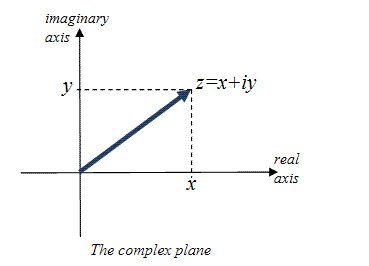
And to visualize these numbers we'll refer to the...
Definition: Complex Plane
The complex plane, much like the cartesian plane, is a grid we use to visualize numbers. But instead of an $x$ and $y$ axis there is a $real$ and $imaginary$ axis.
Example: Plotting Complex Numbers
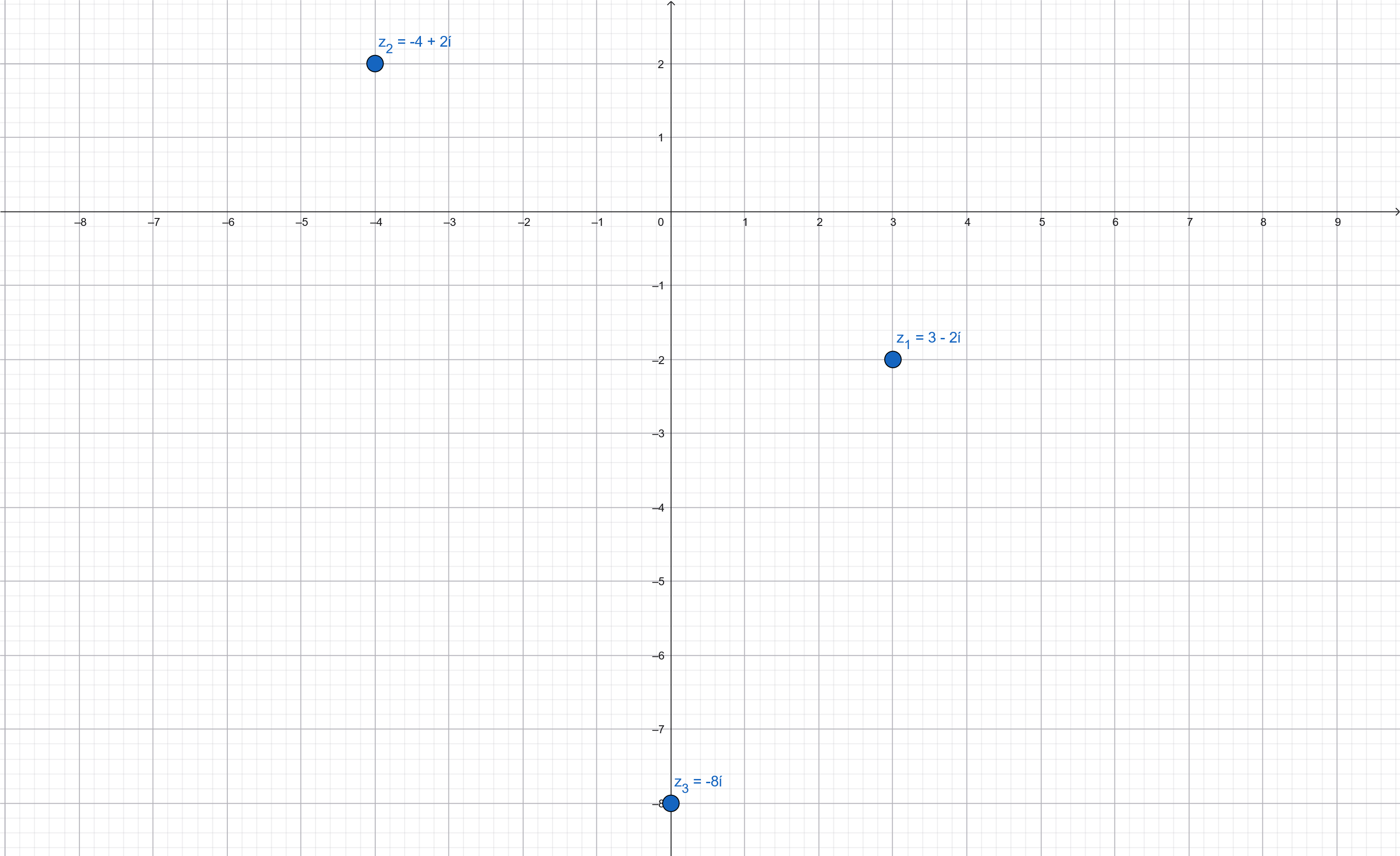
Plot the following numbers in the complex plane.
- $z_1=3-2i$
- $z_2=-4+2i$
- $z_3=-8i$
::solution
:::
MyOpenMath: Try your own!
Properties of Complex Numbers
Complex numbers, unlike real numbers, cannot be ordered. If you have two complex numbers $z_1$ and $z_2$ it does not make sense to say something like $z_1<z_2$. Instead, we compare the size of the complex number.
Definition: Absolute Value of a Complex Number
The absolute value of a complex number $z=a+bi$ is its distance from 0.
$$ |z|=\sqrt{a^2+b^2} $$
This value is also called the modulus or the magnitude of the complex number depending on which textbook you pick up.
Warning
Note that the imaginary unit $i$ is not part of this calculation. Do not include $i$ when you calculate $|z|$!
Additionally, every complex number has a conjugate, which is the number that has the same size, but whose imaginary part has the opposite sign. You might remember from algebra that complex solutions to polynomials come in conjugate pairs.
Definition: Complex Conjugate
The complex conjugate of an imaginary number $z=a+bi$ is $a-bi$ and is denoted:
$$\overline{z}=a-bi$$
Example: Find $|z|$ and $\overline{z}$
Find the absolute value of the following complex numbers.
- $z_1=12-5i$
- $z_2=-64+120i$
- $z_3=-7-24i$
::solution
For $z_1=12-5i$:
\[ \begin{align*} |z_1|&=\sqrt{12^2+(-5)^2}=\sqrt{144+25}=\sqrt{169}=13 \\ \overline{z_1}&=12+5i \end{align*} \]For $z_2=-64+120i$:
\[ \begin{align*} |z_2|&=\sqrt{(-64)^2+120^2}=\sqrt{4096+14400}=\sqrt{18496}=136 \\ \overline{z_2}&=-64-120i \end{align*} \]For $z_3=-7-24i$:
\[ \begin{align*} |z_3|&=\sqrt{(-7)^2+(-24)^2}=\sqrt{49+576}=\sqrt{625}=25 \\ \overline{z_3}&=-7+24i \end{align*} \]
:::
MyOpenMath: Absolute Values
MyOpenMath: Conjugates
To add or subtract complex numbers, we need only to add or subtract their parts respectively. To multiply we need to distribute, as we would with real numbers. And to divide, you'll need to use the complex conjugate to fully simplify.
Given two complex numbers $z_1=a+bi$ and $z_2=c+di$:
$z_1 + z_2= (a+bi) + (c+di) = (a+c) + (b+d)i$
$z_1 \cdot z_2= (a+bi)(c+di)=ac+adi+bci+bi\cdot di=(ac-bd)+(ad+bc)i$
Fact
Multiplying a number by its complex conjugate makes it equal to the square of its real part plus the square of its imaginary part. This is incredibly useful in many calculations. It is used here to simplify division back into a real plus imaginary part.
$$z\cdot \overline{z}=(a+bi)(a-bi)=a^2-abi+abi-(bi)^2=a^2+b^2$$
MyOpenMath: Multiply by Conjugate
Now let's look at how this makes division a bit easier.
Example: Multiply and Divide Complex numbers
Given $z=15+8i$ and $w=7+24i$, find $zw$ and $\frac{z}{w}$
::solution First, mutliplication.
This is just FOIL (first outter inner last), but I jokingly say its better to FLOI. You multiply the first and last terms to get the real part and then the outer and inner terms to get the imaginary part.
Use the complex conjugate of the denominator to simplify.
So,
$$ \frac{z}{w}=\frac{297}{625}-\frac{304}{625}i $$ :::
MyOpenMath: Divide Complex Numbers
Polar Coordinates for Complex Numbers
Because complex numbers are in a plane, they too can be described in terms of an angle and distance from the origin. This turns out to be incredibly useful for working with complex numbers.
Definition: Polar Form of a Complex Number
The complex number $z=a+bi$ can be written as $(r,\theta)$ with magnitude $r=|z|=\sqrt{a^2+b^2}$ and $\theta$ can be found with:
Furthermore, with $a=r \cos\theta$ and $b = r \sin\theta$ the expression
$$ r(\cos\theta + i \sin\theta) $$
is referred to as the polar form of $z$.
Fact: Shorthand for Rectangular to Polar Form
Given a complex number in polar form $(r,\theta)$ we can convert it to rectangular form by using $r \cos\theta + i r \sin\theta$
This is quite the expression to be writing over and over again. It is standard practice to write the polar form of a complex number as $r$cis$\theta$ where cis$\theta$ means $\cos\theta + i \sin\theta$.
Example: Convert Rectangular to Polar
Convert the following complex numbers to polar form. Give your answer as $r$cis$\theta$.
- $-2-2i$
- $3\sqrt{3}-3i$
- $9-7i$
::solution
- $z=-2-2i$
\[ \begin{align*} r&=\sqrt{(-2)^2+(-2)^2}=\sqrt{8}=2\sqrt{2} \\ \theta&=225^\circ \end{align*} \]
So $z=2\sqrt{2}$cis$225^\circ$.
- $z=3\sqrt{3}-3i$
\[ \begin{align*} r&=\sqrt{(3\sqrt{3})^2+(-3)^2}=\sqrt{27+9}=6 \\ \theta&=330^\circ \end{align*} \]
So $z=6$cis$330^\circ$.
- $z=9-7i$
\[ \begin{align*} r&=\sqrt{9^2+(-7)^2}=\sqrt{130} \\ \theta&=\tan^{-1}\left(\frac{-7}{9}\right)\approx -37.9^\circ \end{align*} \]
Since the point is in quadrant IV, we can write $\theta\approx 322.1^\circ$.
So $z=\sqrt{130}$cis$322.1^\circ$.
:::
MyOpenMath: Rectangular to Polar
Example: Convert Polar to Rectangular
Given a complex number as $r$cis$\theta$, convert it to rectangular form $a+bi$.
- $6$cis$210^\circ$
- $8$cis$225^\circ$
- $-2$cis$\frac{4\pi}{3}$
- $17$cis$\frac{13\pi}{12}$
::solution
$6$cis$210^\circ$
\[ \begin{align*} z&=6(\cos 210^\circ+i\sin 210^\circ) \\ &=6\left(-\frac{\sqrt{3}}{2}-\frac{1}{2}i\right) \\ &=-3\sqrt{3}-3i \end{align*} \]$8$cis$225^\circ$
\[ \begin{align*} z&=8(\cos 225^\circ+i\sin 225^\circ) \\ &=8\left(-\frac{\sqrt{2}}{2}-\frac{\sqrt{2}}{2}i\right) \\ &=-4\sqrt{2}-4\sqrt{2}i \end{align*} \]$-2$cis$\frac{4\pi}{3}$
\[ \begin{align*} z&=-2\left(\cos\frac{4\pi}{3}+i\sin\frac{4\pi}{3}\right) \\ &=-2\left(-\frac{1}{2}-\frac{\sqrt{3}}{2}i\right) \\ &=1+\sqrt{3}i \end{align*} \]$17$cis$\frac{13\pi}{12}$
\[ \begin{align*} z&=17\left(\cos\frac{13\pi}{12}+i\sin\frac{13\pi}{12}\right) \\ &=17\left(-\frac{\sqrt{6}+\sqrt{2}}{4}-\frac{\sqrt{6}-\sqrt{2}}{4}i\right) \\ &=-\frac{17(\sqrt{6}+\sqrt{2})}{4}-\frac{17(\sqrt{6}-\sqrt{2})}{4}i \end{align*} \]
:::
MyOpenMath Question
Products and Quotients in Polar Form
It happens to be the case that multiplying and dividing complex numbers is way easier in polar form. Due to some geometries better explored in another class, multiplying two complex numbers ends up adding their angles and multiplying their magnitudes.
Theorem: DeMoivre's Theorem
Given two complex numbers $z_1=r_1(\cos\theta_1+i\sin\theta_1)$ and $z_1=r_2(\cos\theta_2+i\sin\theta_2)$, with $n\in\mathbb{Z}$ the following holds.
- $z_1 z_2=r_1 r_2(\cos(\theta_1+\theta_2)+i\sin(\theta_1+\theta_2))$
- $\frac{z_1}{z_2}=\frac{r_1}{r_2}(\cos(\theta_1-\theta_2)+i\sin(\theta_1-\theta_2))$
- $(z_1)^n=r_z^n(\cos(n\theta_1)+i\sin(n\theta_1))$
- $\sqrt[n]{z_1}=z^\frac{1}{n}(\cos\left(\frac{\theta_1+2\pi k}{n}\right)+i\sin\left(\frac{\theta_1+2\pi k}{n}\right))$ with $k\in {0,1,2,...,n-1}$
Example: Bruh...
To see how these can make a problem easier, consider calculating something like $(1+i)^6$ in rectangular coordinates. Then calculate it in polar coordinates.
Show Solution
Rectangular calculation (repeated multiplication):
So in rectangular form, $(1+i)^6=-8i$.
Polar calculation:
Both methods agree: $(1+i)^6=-8i$.
Example: Multiply and Divide
Let $z=\frac{\sqrt{2}}{2}-\frac{\sqrt{2}}{2}i$ and $w=-\frac{1}{2}+\frac{\sqrt{3}}{2}i$. Find the following:
- $zw$
- $\frac{z}{w}$
Show Solution
Write each number in polar form first:
Then use product and quotient rules in polar form.
MyOpenMath Question
Example: Exponentiation in polar form
- $z=\sqrt{2}$cis$\left(\frac{5\pi}{6}\right)$, find $z^6$
- $w=3$cis$(10^\circ)$, find $w^3$
::solution Use DeMoivre's theorem: $(r\text{cis}\theta)^n=r^n\text{cis}(n\theta)$.
- $z=\sqrt{2}\text{cis}\left(\frac{5\pi}{6}\right)$
\[ \begin{align*} z^6&=\left(\sqrt{2}\text{cis}\left(\frac{5\pi}{6}\right)\right)^6 \\ &=(\sqrt{2})^6\text{cis}\left(6\cdot\frac{5\pi}{6}\right) \\ &=8\text{cis}(5\pi) \\ &=8(\cos 5\pi+i\sin 5\pi) \\ &=8(-1+0i)=-8 \end{align*} \]
So $z^6=-8$.
- $w=3\text{cis}(10^\circ)$
\[ \begin{align*} w^3&=\left(3\text{cis}(10^\circ)\right)^3 \\ &=3^3\text{cis}(3\cdot 10^\circ) \\ &=27\text{cis}(30^\circ) \\ &=27\left(\cos 30^\circ+i\sin 30^\circ\right) \\ &=27\left(\frac{\sqrt{3}}{2}+\frac{1}{2}i\right) \\ &=\frac{27\sqrt{3}}{2}+\frac{27}{2}i \end{align*} \]
So $w^3=\frac{27\sqrt{3}}{2}+\frac{27}{2}i$.
:::
MyOpenMath: $z^n$ example
Recall that last bit of DeMoivre's above, the one about roots?
$$\sqrt[n]{z_1}=z^\frac{1}{n}(\cos\left(\frac{\theta_1+2\pi k}{n}\right)+i\sin\left(\frac{\theta_1+2\pi k}{n}\right))$$
with $k\in {0,1,2,...,n-1}$
Well, it turns out that when extracting the $n$th root of a number, there are $n$ of them. You've seen this before. What number satisfies $x^2=4$? The principal square root says $2$. But it's also true that $(-2)^2=4$. Similarly, if I ask what the solutions to $x^3=125$ are, you might say 5. It is true that $5^3=125$, after all. But there are, in fact, two more solutions.
Example: DeMoivre's Roots
Find all 3 complex solutions to $\sqrt[3]{125}$
::solution We know that $125=125+0i=125$cis$(0)$. But it's also true that you can add $2\pi$ to any angle and get the same values for the trig functions. So it's also true that $125=125$cis$(0+2\pi k)$ for some integer $k$. Applying DeMoivre,
So if we pick $k$ we can find solutions to the original equation. DeMoivre tells us that we only need to pick up to $n$ to find all of the unique ones. Since for $x^3=125$ has an $n$ of 3, we're gonna choose $k\in{0,1,2}$.
(remember how solutions came in conjugate pairs!) So the 3 solutions to $x^3=125$ are $x=5,-\frac{5}{2}+i\frac{5\sqrt{3}}{2},-\frac{5}{2}-i\frac{5\sqrt{3}}{2}$. :::
Example: Complex Roots
- $z=343(\cos\left(\frac{2\pi}{3}\right)+i\sin\left(\frac{2\pi}{3}\right))$, find $\sqrt[3]{z}$
- $w=16(\cos\left(\frac{5\pi}{4}\right)+i\sin\left(\frac{5\pi}{4}\right))$, find $\sqrt[4]{w}$
- $v=128(\cos\left(\frac{11\pi}{6}\right)+i\sin\left(\frac{11\pi}{6}\right))$, find $\sqrt[7]{v}$
::solution Use
$$ \sqrt[n]{r\text{cis}(\theta)}=\sqrt[n]{r},\text{cis}\left(\frac{\theta+2\pi k}{n}\right),\quad k=0,1,\dots,n-1 $$
- $z=343\text{cis}\left(\frac{2\pi}{3}\right)$, so
\[ \begin{align*} \sqrt[3]{z}&=\sqrt[3]{343}\,\text{cis}\left(\frac{\frac{2\pi}{3}+2\pi k}{3}\right) \\ &=7\,\text{cis}\left(\frac{2\pi}{9}+\frac{2\pi k}{3}\right),\quad k=0,1,2 \end{align*} \]
So the three roots are
$$ 7\text{cis}\left(\frac{2\pi}{9}\right),\quad 7\text{cis}\left(\frac{8\pi}{9}\right),\quad 7\text{cis}\left(\frac{14\pi}{9}\right) $$
- $w=16\text{cis}\left(\frac{5\pi}{4}\right)$, so
\[ \begin{align*} \sqrt[4]{w}&=\sqrt[4]{16}\,\text{cis}\left(\frac{\frac{5\pi}{4}+2\pi k}{4}\right) \\ &=2\,\text{cis}\left(\frac{5\pi}{16}+\frac{\pi k}{2}\right),\quad k=0,1,2,3 \end{align*} \]
So the four roots are
$$ 2\text{cis}\left(\frac{5\pi}{16}\right),\quad 2\text{cis}\left(\frac{13\pi}{16}\right),\quad 2\text{cis}\left(\frac{21\pi}{16}\right),\quad 2\text{cis}\left(\frac{29\pi}{16}\right) $$
- $v=128\text{cis}\left(\frac{11\pi}{6}\right)$, so
\[ \begin{align*} \sqrt[7]{v}&=\sqrt[7]{128}\,\text{cis}\left(\frac{\frac{11\pi}{6}+2\pi k}{7}\right) \\ &=2\,\text{cis}\left(\frac{11\pi}{42}+\frac{2\pi k}{7}\right),\quad k=0,1,2,3,4,5,6 \end{align*} \]
So the seven roots are
$2\text{cis}\left(\frac{11\pi}{42}\right)$, $2\text{cis}\left(\frac{23\pi}{42}\right)$, $2\text{cis}\left(\frac{35\pi}{42}\right)$, $2\text{cis}\left(\frac{47\pi}{42}\right)$, $2\text{cis}\left(\frac{59\pi}{42}\right)$, $2\text{cis}\left(\frac{71\pi}{42}\right)$, and $2\text{cis}\left(\frac{83\pi}{42}\right)$
:::