Further Applications of Trigonometry
10.3 Polar Coordinates
Cartesian vs Polar Coordinates
Cartesian, or rectangular, coordinates are not the only way to describe a point in the 2D plane. The rectangular way is to describe a point as an x and a y, the horizontal and vertical distance from the origin. In many cases, it is more natural to describe a coordinate as an angle and a distance. The angle is usually labeled theta and is measured in standard position while the distance is marked as r as if it were the radius of a circle.
Definition: Polar Coordinate
Any point in the Cartesian coordinate system can be described in polar coordinates $(r,\theta)$ where $r$ is its distance from the origin and $\theta$ is the angle measured in standard position.
Warning
Polar coordinates are not unique. One can always add $2\pi$ to $\theta$ and describe the same point.
$$(r,\theta) = (r,\theta + 2\pi k)$$
where $k$ is an integer.
Example: Plotting polar coordinates
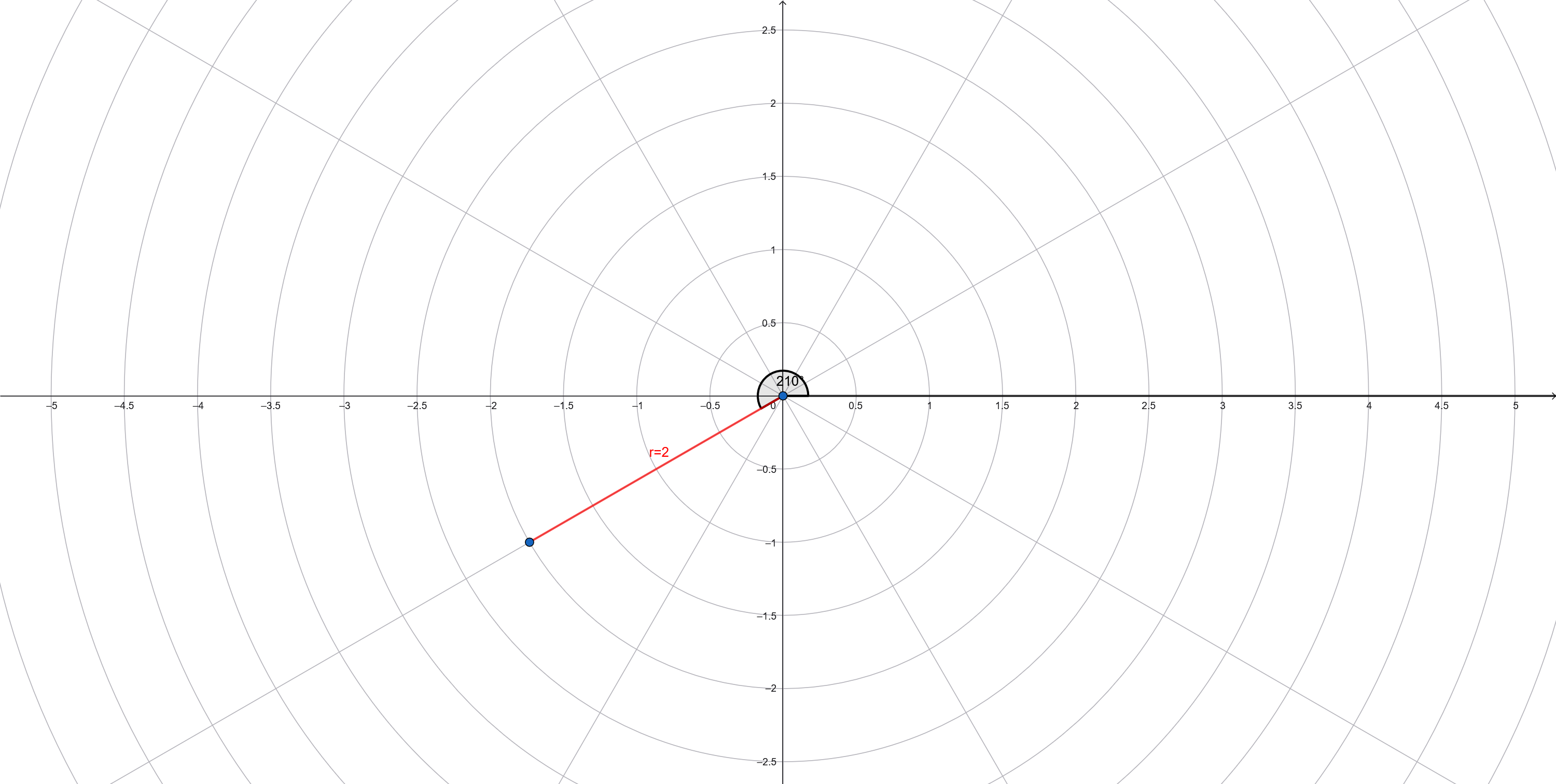
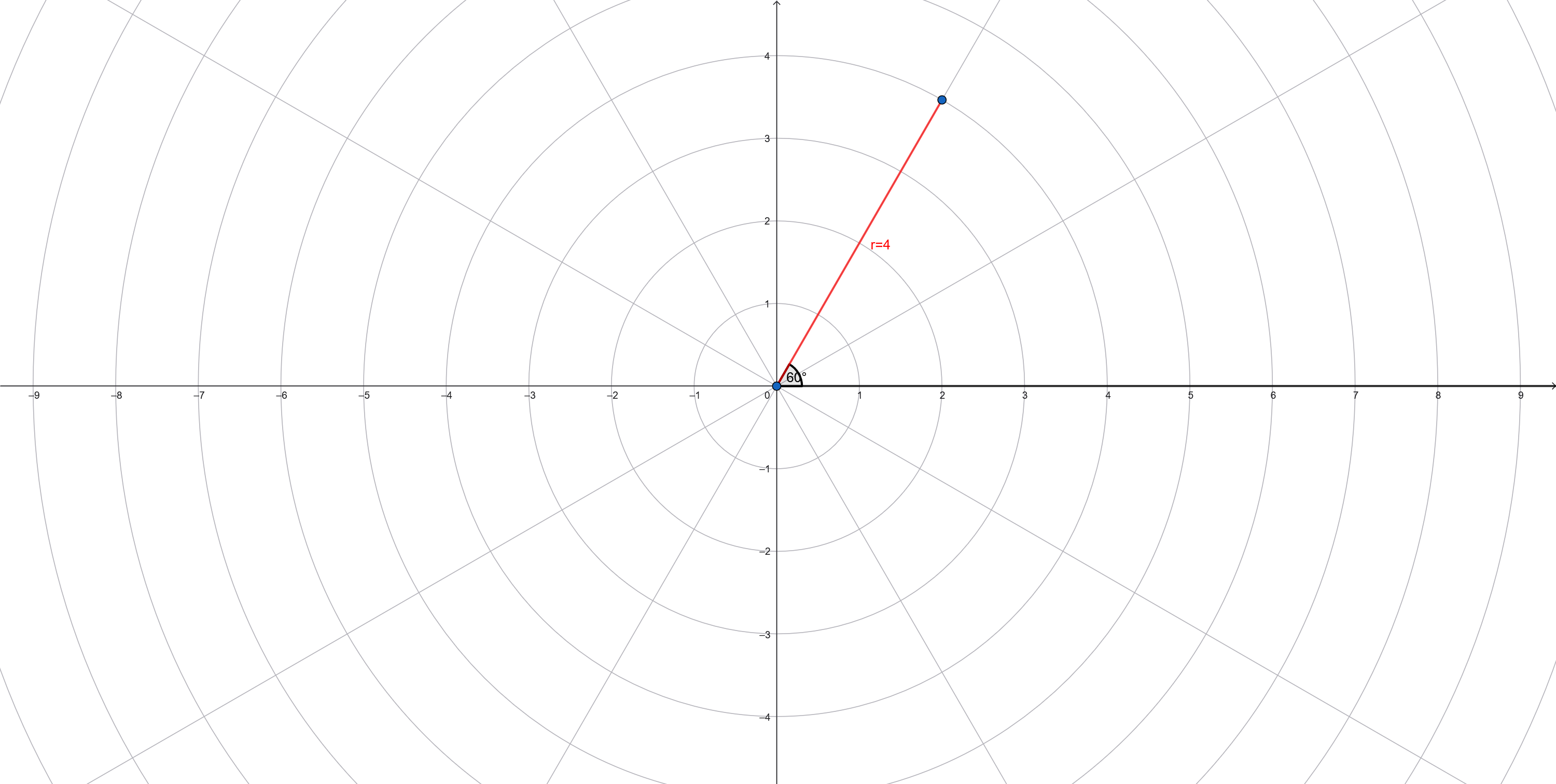
Plot the following polar coordinates:
- $(2,210^\circ)$
- $(2,-150^\circ)$
- $(4,60^\circ)$
- $(4,420^\circ)$
Show Solution
MyOpenMath: Try your own!
Negative r and $\theta$
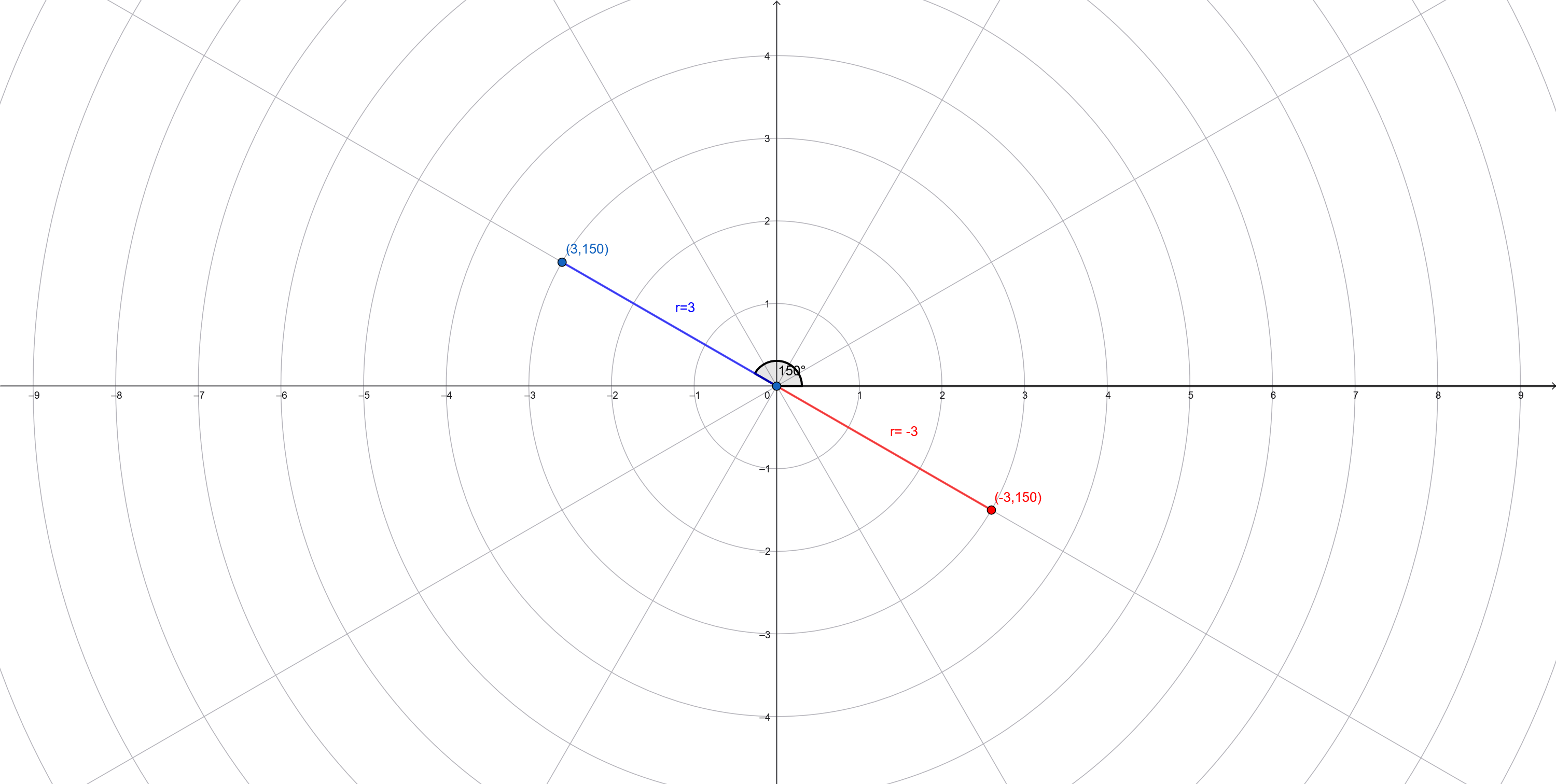
Both r and $\theta$ can be negative in polar coordinates. A negative angle should be intuitive by this point; one only needs to measure clockwise from the positive x-axis. A negative r value is similar in that we're going backwards. We measure the angle as usual, then instead of moving from the origin into the quadrant that the angle is pointing to, we move away from that quadrant exactly $180^\circ$ from the measured $\theta$.
Definition
Given the polar coordinate $(r,\theta)$
$$(r,\theta)=(-r,\theta + 180^\circ)$$
Example: Plot polar coordinates
Plot the following polar coordinates.
- $(-3,\frac{\pi}{2})$
- $(-5,\frac{5\pi}{3})$
- $(-2,-390^\circ)$
Show Solution
Example: Rewrite coordinates
Rewrite $(3,\frac{5\pi}{6})$ with the following conditions:
- $r>0$, $-2\pi<\theta<0$
- $r>0$, $2\pi<\theta<4\pi$
- $r<0$, $0<\theta<2\pi$
Show Solution
- $(3,\frac{5\pi}{6})\implies (3,\frac{5\pi}{6}-2\pi)\implies (3,-\frac{7\pi}{6})$
- $(3,\frac{5\pi}{6})\implies (3,\frac{5\pi}{6}+2\pi)\implies (3,\frac{17\pi}{6})$
- $(3,\frac{5\pi}{6})\implies (-3,\frac{5\pi}{6}+\pi)\implies (-3,\frac{11\pi}{6})$
MyOpenMath: Try your own!
Example: Identify point from graph
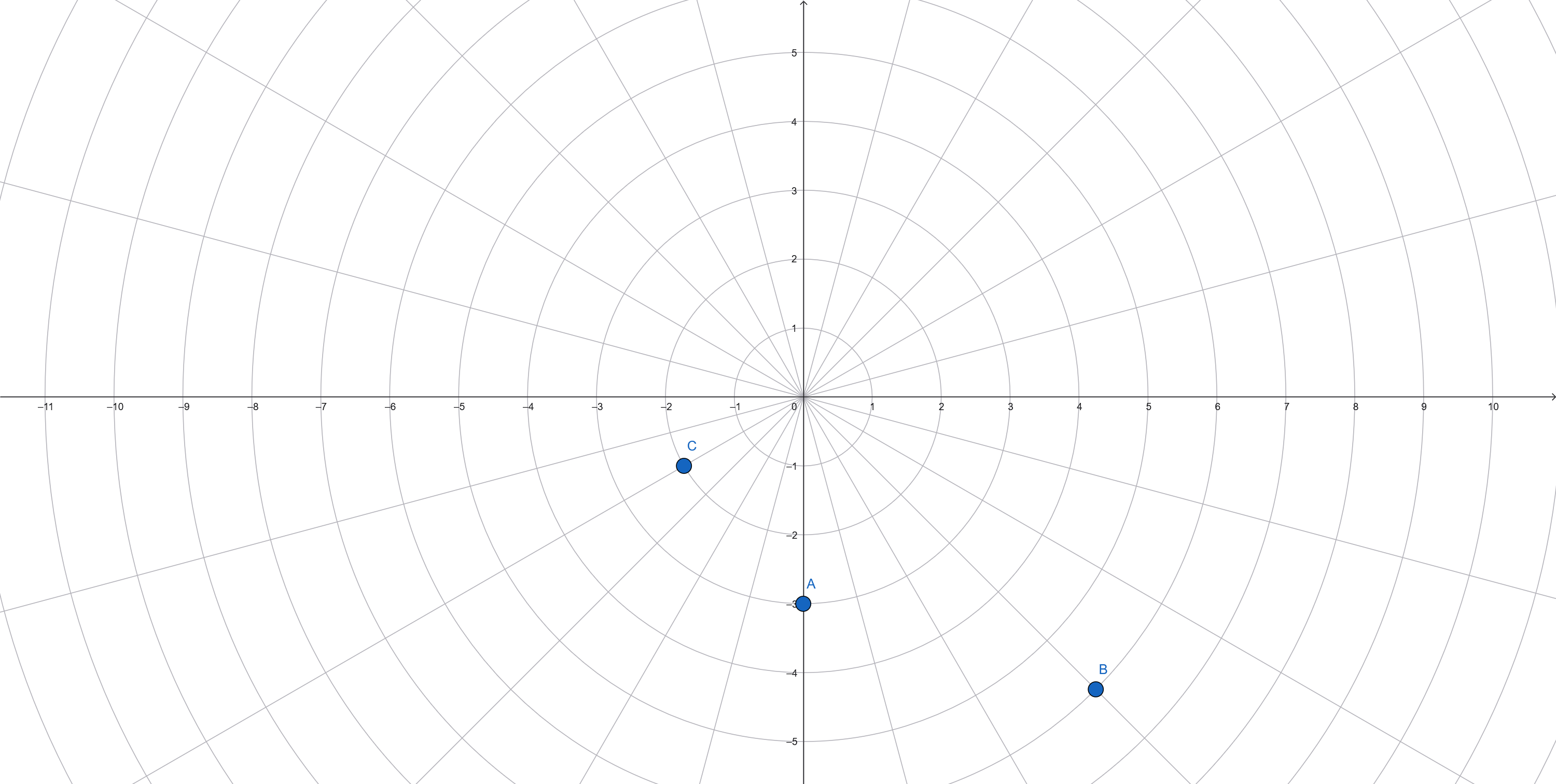
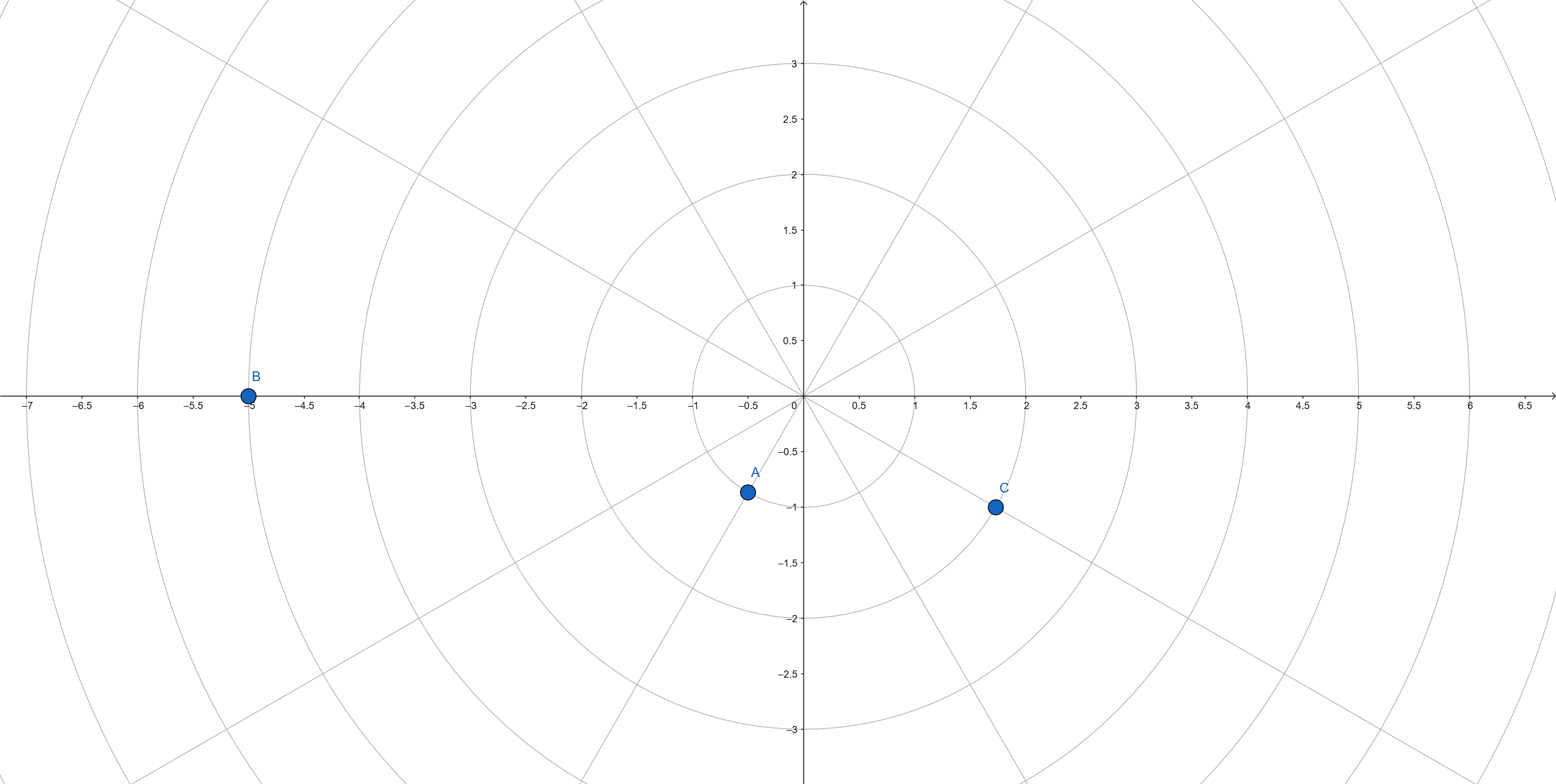
For the following graphs, write the point shown in polar coordinates with $r>0$, and $0\leq\theta<360^\circ$ or $0\leq\theta<2\pi$
Show Solution
- $(1,240^\circ)$ or $(1,\frac{4\pi}{3})$
- $(5,180^\circ)$ or $(5,\pi)$
- $(2,330^\circ)$ or $(2,\frac{11\pi}{6})$
MyOpenMath: Try your own!
Converting Coordinates
Now we'll work on converting between our two coordinate systems. Luckily for us, if you draw a line from the origin to any point in the Cartesian plane, we get a nice right triangle, which means everything we need comes from good ol' Pythagoras.
Fact
$x=r \cos \theta$, $y=r \sin\theta$, and $r=\sqrt{x^2+y^2}$ furthermore,
If $\theta$ is on an axis, the angle will be $0^\circ$, $90^\circ$,$180^\circ$, or $270^\circ$. Also recall that polar coordinates are not unique. We can always add any multiple of $360^\circ$ and be in exactly the same spot.
Example: Polar to Rectangular
Convert each of the following polar coordinates to rectangular coordinates.
- $\left(6,\frac{\pi}{6}\right)$
- $\left(-4,-\frac{\pi}{4}\right)$
- $\left(3,\frac{5\pi}{3}\right)$
- $\left(-5,\frac{7\pi}{6}\right)$
::solution
- Use $x=r\cos(\theta)$ and $y=r\sin(\theta)$.
\[ \begin{align*} x&=6\cos\left(\frac{\pi}{6}\right)=6\cdot\frac{\sqrt{3}}{2}=3\sqrt{3}\\ y&=6\sin\left(\frac{\pi}{6}\right)=6\cdot\frac{1}{2}=3 \end{align*} \]
So the rectangular coordinates are $(3\sqrt{3},3)$.
- Use $x=r\cos(\theta)$ and $y=r\sin(\theta)$.
\[ \begin{align*} x&=-4\cos\left(-\frac{\pi}{4}\right)=-4\cdot\frac{\sqrt{2}}{2}=-2\sqrt{2}\\ y&=-4\sin\left(-\frac{\pi}{4}\right)=-4\cdot\left(-\frac{\sqrt{2}}{2}\right)=2\sqrt{2} \end{align*} \]
So the rectangular coordinates are $(-2\sqrt{2},2\sqrt{2})$.
- Use $x=r\cos(\theta)$ and $y=r\sin(\theta)$.
\[ \begin{align*} x&=3\cos\left(\frac{5\pi}{3}\right)=3\cdot\frac{1}{2}=\frac{3}{2}\\ y&=3\sin\left(\frac{5\pi}{3}\right)=3\cdot\left(-\frac{\sqrt{3}}{2}\right)=-\frac{3\sqrt{3}}{2} \end{align*} \]
So the rectangular coordinates are $\left(\frac{3}{2},-\frac{3\sqrt{3}}{2}\right)$.
- Use $x=r\cos(\theta)$ and $y=r\sin(\theta)$.
\[ \begin{align*} x&=-5\cos\left(\frac{7\pi}{6}\right)=-5\cdot\left(-\frac{\sqrt{3}}{2}\right)=\frac{5\sqrt{3}}{2}\\ y&=-5\sin\left(\frac{7\pi}{6}\right)=-5\cdot\left(-\frac{1}{2}\right)=\frac{5}{2} \end{align*} \]
So the rectangular coordinates are $\left(\frac{5\sqrt{3}}{2},\frac{5}{2}\right)$.
:::
MyOpenMath: Try your own!
Example: Rectangular to Polar
Convert each of the following rectangular coordinates to polar coordinates.
- $(1,-\sqrt{3})$
- $(-3,3)$
- $(2\sqrt{3},-2)$
- $(0,-9)$
::solution
- First find $r$.
\[ \begin{align*} r&=\sqrt{x^2+y^2}\\ r&=\sqrt{1^2+(-\sqrt{3})^2}\\ r&=\sqrt{1+3}=2 \end{align*} \]\[ \theta=\tan^{-1}\left(\frac{-\sqrt{3}}{1}\right)=\tan^{-1}(-\sqrt{3})=-\frac{\pi}{3} \]
Since the point $(1,-\sqrt{3})$ is in quadrant IV, $\theta=\frac{5\pi}{3}$.
So the polar coordinates are $\left(2,\frac{5\pi}{3}\right)$.
- First find $r$.
\[ \begin{align*} r&=\sqrt{x^2+y^2}\\ r&=\sqrt{(-3)^2+3^2}\\ r&=\sqrt{9+9}=\sqrt{18}=3\sqrt{2} \end{align*} \]\[ \theta_{ref}=\tan^{-1}\left(\left|\frac{3}{-3}\right|\right)=\tan^{-1}(1)=\frac{\pi}{4} \]
Since the point $(-3,3)$ is in quadrant II, we get $\theta=\pi-\frac{\pi}{4}=\frac{3\pi}{4}$.
So the polar coordinates are $\left(3\sqrt{2},\frac{3\pi}{4}\right)$.
- First find $r$.
\[ \begin{align*} r&=\sqrt{x^2+y^2}\\ r&=\sqrt{(2\sqrt{3})^2+(-2)^2}\\ r&=\sqrt{12+4}=4 \end{align*} \]\[ \theta=\tan^{-1}\left(\frac{-2}{2\sqrt{3}}\right)=\tan^{-1}\left(-\frac{1}{\sqrt{3}}\right)=-\frac{\pi}{6} \]
Since the point $(2\sqrt{3},-2)$ is in quadrant IV, we get $\theta=\frac{11\pi}{6}$.
So the polar coordinates are $\left(4,\frac{11\pi}{6}\right)$.
- First find $r$.
\[ \begin{align*} r&=\sqrt{x^2+y^2}\\ r&=\sqrt{0^2+(-9)^2}\\ r&=9 \end{align*} \]
Since $x=0$, the ratio $\frac{y}{x}$ is undefined, so inverse tangent is not the right tool here. The point $(0,-9)$ is on the negative y-axis, so $\theta=\frac{3\pi}{2}$.
So the polar coordinates are $\left(9,\frac{3\pi}{2}\right)$.
:::
MyOpenMath: Try your own!
Converting Equations to Polar Coordinates
If we can describe points in polar coordinates, then we can describe entire equations in polar coordinates. And in some cases, it is easier to do so. Take for example the equation of a circle.
$$x^2+y^2=1$$
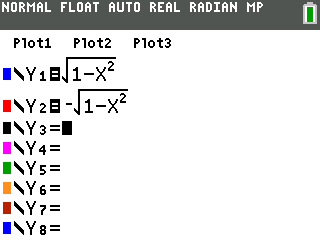
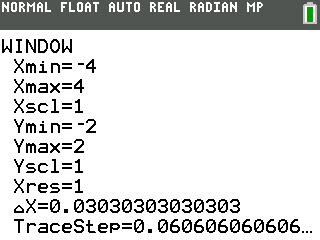
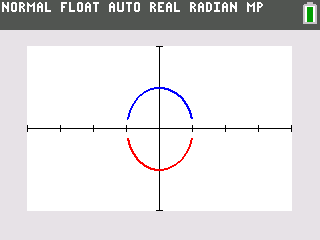
This is a circle centered at the origin with a radius of 1. This isn't a function of either $x$ or $y$, because it would fail the vertical or horizontal line test. If you wanted to graph it in an older TI-83/84 calculator then you would have to create two separate equations when solving for $y$.
This means we would have to plot the top half of the circle, $f(x)=\sqrt{1-x^2}$ and then the bottom half $f(x)=-\sqrt{1-x^2}$.
| Y= Screen | Window Settings | Graph |
|---|---|---|
 |
 |
 |
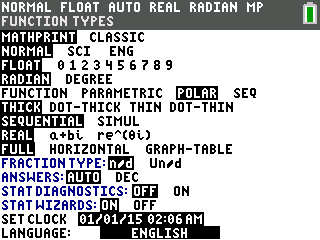
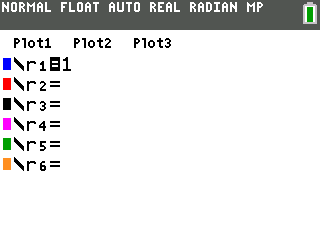
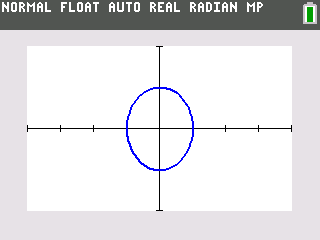
However, a circle can be written as a function of its radius when using polar coordinates, $f(\theta)=1$. When $\theta$ is at $0$, our value is one and we slowly maintain that distance of 1 from the origin as $\theta$ wraps around to $2\pi$. Most modern calculators have a polar option for graphing. For the TI-84 used in this example, the setting can be found under MODE. You can see here that after the setting is changed, the Y= menu asks for $r$ instead of $y$, because now instead of $y=f(x)$ we're working with a radius described as a function of its angle, $r=f(\theta)$. In our case, $r=1$
| MODE Screen | r= Screen | Graph |
|---|---|---|
 |
 |
 |
Fact: Polar Equations
Recall that for any point in the cartesian plane $(x,y)$ we can build a triangle and calculate its distance from the origin $r=\sqrt{x^2+y^2}$.
$$\cos(\theta)=\frac{x}{r} \quad \text{ and } \quad \sin{\theta}=\frac{y}{r}.$$
Shuffling these around we can obtain
$$x=r\cos\theta \quad \text{ and } \quad y=r\sin\theta.$$
Example: Covert Rectangular Equations to Polar
Gonvert each of the following rectangular equations to polar. Give your answer as $r(\theta)=$ or just $r=$.
- $x^2+y^2=25$
- $x=9$
- $y=3x+2$
- $x^2+y^2=4x$
::solution
- Let's start with the friendliest one: $x^2+y^2=25$.
In polar form, $x^2+y^2=r^2$, so we can substitute immediately.
\[ \begin{align*} x^2+y^2&=25\\ r^2&=25 \end{align*} \]Now solve for $r$. For radius form, we usually take the positive radius description:
\[ r=5 \]So a clean polar equation is $r=5$.
- Next, convert the vertical line $x=9$.
Use $x=r\cos\theta$:
\[ \begin{align*} x&=9\\ r\cos\theta&=9 \end{align*} \]Now isolate $r$ by dividing by $\cos\theta$:
\[ r=\frac{9}{\cos\theta}=9\sec\theta \]So the polar form is $r=9\sec\theta$.
- Now for $y=3x+2$.
Replace $y$ with $r\sin\theta$ and $x$ with $r\cos\theta$:
\[ \begin{align*} y&=3x+2\\ r\sin\theta&=3r\cos\theta+2 \end{align*} \]Let's gather the $r$ terms on one side:
\[ \begin{align*} r\sin\theta-3r\cos\theta&=2\\ r(\sin\theta-3\cos\theta)&=2 \end{align*} \]Now isolate $r$:
\[ r=\frac{2}{\sin\theta-3\cos\theta} \]So one good polar form is $r=\dfrac{2}{\sin\theta-3\cos\theta}$.
- Last one: $x^2+y^2=4x$.
Use $x^2+y^2=r^2$ and $x=r\cos\theta$:
\[ \begin{align*} x^2+y^2&=4x\\ r^2&=4r\cos\theta \end{align*} \]If we divide by $r$ (we're not concerned with $r$ being zero, a circle with a radius of zero is just a point at the origin), we get:
\[ r=4\cos\theta \]So the standard polar form is $r=4\cos\theta$.
:::
MyOpenMath: Try your own!
Example: Convert Polar Equations to Rectangular
Convert each of the following equations polar to rectangular.
- $r=8\cos\theta$
- $r=10$
- $r=2\sin\theta$
::solution
Convert $r=8\cos\theta$ to rectangular.
A great move here is to multiply by $r$ so we can use both identities $r^2=x^2+y^2$ and $r\cos\theta=x$:
\[ \begin{align*} r&=8\cos\theta\\ r^2&=8r\cos\theta \end{align*} \]Now substitute:
\[ \begin{align*} x^2+y^2&=8x \end{align*} \]That is already rectangular form. If you want the circle form, complete the square in $x$:
\[ \begin{align*} x^2-8x+y^2&=0\\ (x-4)^2+y^2&=16 \end{align*} \]- Convert $r=10$.
Square both sides so we can use $r^2=x^2+y^2$:
\[ \begin{align*} r&=10\\ r^2&=100\\ x^2+y^2&=100 \end{align*} \]So the rectangular equation is $x^2+y^2=100$.
- Convert $r=2\sin\theta$.
Again, multiply both sides by $r$:
\[ \begin{align*} r&=2\sin\theta\\ r^2&=2r\sin\theta \end{align*} \]Now substitute $r^2=x^2+y^2$ and $r\sin\theta=y$:
\[ \begin{align*} x^2+y^2&=2y \end{align*} \]To see the graph more clearly, complete the square in $y$:
\[ \begin{align*} x^2+y^2-2y&=0\\ x^2+(y-1)^2&=1 \end{align*} \]So a rectangular form is $x^2+y^2=2y$ (equivalently $x^2+(y-1)^2=1$).
:::