Right Triangle Trigonometry
7.3 The Unit Circle
Building the Unit Circle
The unit circle seems like a mysterious relic that students are forced to memorize, but really it is an incredible idea. Instead of repeatedly thinking about unique triangles and angles for our trig ratios, let's scale all of these triangles down to have a hypotenuse of 1. Then, we build them all with the origin as a center so that the angle in question is in standard position. And as that hypotenuse swings around to all possible locations it traces out a circle. Every point on this circle represents a triangle.
Theorem: The Unit Circle
On the unit circle, each angle $\theta$ corresponds to a point $\big(x,y\big)$ with:
$$ \cos(\theta)=x,\quad \sin(\theta)=y $$
Then: $$ \tan(\theta)=\frac{y}{x},\quad \sec(\theta)=\frac{1}{x},\quad \csc(\theta)=\frac{1}{y},\quad \cot(\theta)=\frac{x}{y} $$ when denominators are nonzero.
Example: Read sin and cos from a benchmark point
Use point $\left(\frac{\sqrt{3}}{2},\frac{1}{2}\right)$ on the unit circle. Find $\sin(\theta)$ and $\cos(\theta)$.
Show Solution
On the unit circle: $$ \cos(\theta)=x,\quad\sin(\theta)=y $$
Here $x=\frac{\sqrt{3}}{2}$ and $y=\frac{1}{2}$, so: $$ \cos(\theta)=\frac{\sqrt{3}}{2},\quad \sin(\theta)=\frac{1}{2} $$
Example: Find all six functions from an angle
Let $\theta=120^\circ$.
Show Solution
From the unit circle: $$ \big(\cos120^\circ,\sin120^\circ\big)=\left(-\frac{1}{2},\frac{\sqrt{3}}{2}\right) $$
So: $$ \sin\theta=\frac{\sqrt{3}}{2},\quad \cos\theta=-\frac{1}{2},\quad \tan\theta=\frac{\sin\theta}{\cos\theta}=\frac{\frac{\sqrt{3}}{2}}{-\frac{1}{2}}=-\sqrt{3} $$
Reciprocals: $$ \csc\theta=\frac{2}{\sqrt{3}}=\frac{2\sqrt{3}}{3},\quad \sec\theta=-2,\quad \cot\theta=-\frac{1}{\sqrt{3}}=-\frac{\sqrt{3}}{3} $$
MyOpenMath: Try your own!
Reference Angles
Recall our special angles that we mentioned earlier, the $30^\circ$, the $45^\circ$, and the $60^\circ$. Because of the incredible symmetries of circles, the angles on the unit circle end up being the only angles we need to think about when doing trig. Reference angles are the bridge between big messy angles and familiar acute-angle values.
Definition: Reference Angle
The reference angle $t'$ is the acute angle between the terminal side of $t$ and the x-axis.
Quadrant formulas in degrees:
$$ \text{QI: } t'=t $$ $$ \text{QII: } t'=180^\circ-t $$ $$ \text{QIII: } t'=t-180^\circ $$ $$ \text{QIV: } t'=360^\circ-t $$
When you look at an angle in quadrant II, $135^\circ$ for example, it shares the same $(x,y)$ point as a $45^\circ$ angle would if we measured it from the other side. That means it will have the same sine and cosine values as long as we adjust for sign. In practice, when finding trig values for $135^\circ$, I find the reference angle first and use that, then adjust for the quadrant I was really in.
$$180^\circ-135^\circ=45^\circ$$
$$\cos(45^\circ)=\frac{\sqrt{2}}{2} \quad \sin(45^\circ)=\frac{\sqrt{2}}{2}$$
But really, the angle was in quadrant II and in quadrant II $x$ values are negative. So
$$\cos(135^\circ)=-\frac{\sqrt{2}}{2} \quad \sin(135^\circ)=\frac{\sqrt{2}}{2}.$$
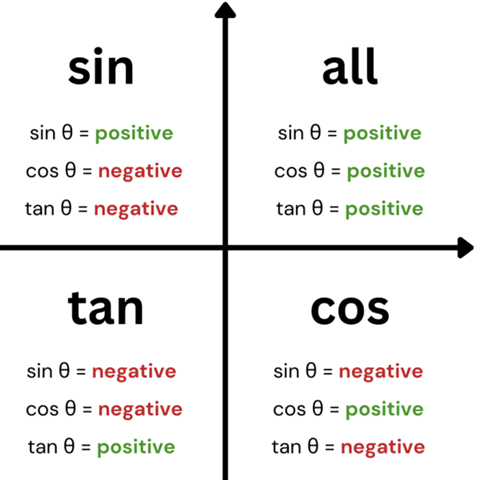
All Students Take Classes
All Students Take Classes is a helpful mnemonic to remember which trig functions are positive in which quadrant. Starting in order, All trig functions are positive in I, only Sine is positive in II, only Tangent is positive in III, and only Cosine is positive in IV.
Example: Reference angle from degree measure
Find the reference angle for $220^\circ$.
Show Solution
Step 1: Determine quadrant. $$ 180^\circ < 220^\circ < 270^\circ $$ So $220^\circ$ is in Quadrant III.
Step 2: Use Quadrant III formula. $$ t'=t-180^\circ=220^\circ-180^\circ=40^\circ $$
Example: Reference angle from a negative radian angle
Find the reference angle for $-\frac{13\pi}{3}$.
Show Solution
First find a coterminal angle in $[0,2\pi)$.
$$ -\frac{13\pi}{3}+2\pi=-\frac{13\pi}{3}+\frac{6\pi}{3}=-\frac{7\pi}{3} $$ $$ -\frac{7\pi}{3}+2\pi=-\frac{7\pi}{3}+\frac{6\pi}{3}=-\frac{\pi}{3} $$ $$ -\frac{\pi}{3}+2\pi=-\frac{\pi}{3}+\frac{6\pi}{3}=\frac{5\pi}{3} $$
So the terminal side is at $\frac{5\pi}{3}$, which is in Quadrant IV.
Reference angle in Quadrant IV: $$ t' = 2\pi-\frac{5\pi}{3}=\frac{\pi}{3} $$
MyOpenMath: Try your own!
Periodicity and Coterminal Thinking
This idea keeps trig manageable: values repeat after fixed angular intervals. No matter the angle we are given, we can place it between $0\leq \theta < 2\pi$. Furthermore, we can turn the problem into thinking about just the first quadrant. It turns out all we ever needed was $1 2 3$
Fact: Periods of Trig Functions
- $\sin$ and $\cos$ have period $2\pi$.
- $\tan$ and $\cot$ have period $\pi$.
- $\sec$ and $\csc$ have period $2\pi$.
So: $$ \sin(\theta+2\pi)=\sin\theta,\quad \cos(\theta+2\pi)=\cos\theta $$ $$ \tan(\theta+\pi)=\tan\theta,\quad \cot(\theta+\pi)=\cot\theta $$
Example: True or false checks
Decide true or false:
- There exists $\theta$ with $\sin(\theta)=-3$.
- $210^\circ$ and $-150^\circ$ have the same trig values.
- $\frac{5\pi}{3}$ and $-\frac{\pi}{3}$ have the same trig values.
Show Solution
- False. On unit circle, $y=\sin(\theta)$ and $-1\le y\le 1$.
- True.
$$ -150^\circ + 360^\circ = 210^\circ $$
Coterminal angles share trig values.
- True.
$$ -\frac{\pi}{3}+2\pi=-\frac{\pi}{3}+\frac{6\pi}{3}=\frac{5\pi}{3} $$
Again coterminal, so same trig values.
Using the Unit Circle for Exact Values
We'll put these new tools to use now.
Example: Evaluate exact trig values
Find each exact value:
- $\sin\left(\frac{25\pi}{6}\right)$
- $\cos\left(-\frac{5\pi}{4}\right)$
- $\tan\left(\frac{3\pi}{2}\right)$
Show Solution
- Reduce by $2\pi$:
$$ \frac{25\pi}{6}-\frac{24\pi}{6}=\frac{\pi}{6} $$
So: $$ \sin\left(\frac{25\pi}{6}\right)=\sin\left(\frac{\pi}{6}\right)=\frac{1}{2} $$
- Use evenness of cosine or unit circle:
$$
\cos\left(-\frac{5\pi}{4}\right)=\cos\left(\frac{5\pi}{4}\right)
$$
The reference angle for $\frac{5\pi}{4}$ is $\frac{\pi}{4}$ so I know I'm working with $\frac{\sqrt{2}}{2}$, but it is in quadrant II and cosine is negative there. So...
$$ \cos\left(-\frac{5\pi}{4}\right)=-\frac{\sqrt{2}}{2} $$
- At $\frac{3\pi}{2}$, point is $(0,-1)$, so $$ \tan\left(\frac{3\pi}{2}\right)=\frac{y}{x}=\frac{-1}{0} $$ which is undefined.
Example: Find all six functions at $\theta=-330^\circ$
Show Solution
Add $360^\circ$: $$ -330^\circ+360^\circ=30^\circ $$ So values are same as at $30^\circ$.
$$ \sin\theta=\frac{1}{2},\quad \cos\theta=\frac{\sqrt{3}}{2},\quad \tan\theta=\frac{\sqrt{3}}{3} $$ $$ \csc\theta=2,\quad \sec\theta=\frac{2}{\sqrt{3}}=\frac{2\sqrt{3}}{3},\quad \cot\theta=\sqrt{3} $$
Example: Find all six functions at $\theta=240^\circ$
Show Solution
First, let's find the reference angle. Since $180^\circ < 240^\circ < 270^\circ$, the angle lands in Quadrant III. The Quadrant III formula gives us: $$ t' = t - 180^\circ = 240^\circ - 180^\circ = 60^\circ $$
Great, so our reference angle is $60^\circ$. That's one of our special angles, so we know all six trig values for it exactly: $$ \sin60^\circ=\frac{\sqrt{3}}{2},\quad \cos60^\circ=\frac{1}{2},\quad \tan60^\circ=\sqrt{3} $$ $$ \csc60^\circ=\frac{2\sqrt{3}}{3},\quad \sec60^\circ=2,\quad \cot60^\circ=\frac{\sqrt{3}}{3} $$
Now we just need to fix the signs for Quadrant III. Remember All Students Take Classes: in Quadrant III, only tangent (and its reciprocal cotangent) are positive. Both sine and cosine — and their reciprocals — are negative there.
So we keep tangent and cotangent as-is, and flip the signs on everything else: $$ \sin240^\circ=-\frac{\sqrt{3}}{2},\quad \cos240^\circ=-\frac{1}{2},\quad \tan240^\circ=\sqrt{3} $$ $$ \csc240^\circ=-\frac{2\sqrt{3}}{3},\quad \sec240^\circ=-2,\quad \cot240^\circ=\frac{\sqrt{3}}{3} $$
MyOpenMath: Try your own!
Try out this game if you really want to nail down finding values on the unit circle quickly. Screen shot your high scores and maybe earn some bonus points in class.
Finding Remaining Functions from One Given Value
This is the capstone skill: combine sign information and identities to reconstruct everything else.
Example: Given quadrant and cosine, find all remaining trig values
Given $t$ is in Quadrant IV and $$ \cos(t)=\frac{2}{7} $$ find the other five trig functions.
Show Solution
Interpret cosine as x-coordinate on unit circle triangle: $$ x=\frac{2}{7},\quad r=1 $$
Use $$ x^2+y^2=1 $$ $$ \left(\frac{2}{7}\right)^2+y^2=1 $$ $$ \frac{4}{49}+y^2=1 $$ $$ y^2=1-\frac{4}{49}=\frac{45}{49} $$ $$ y=\pm\frac{3\sqrt{5}}{7} $$
Since Quadrant IV has negative $y$: $$ y=-\frac{3\sqrt{5}}{7} $$
Now list functions: $$ \sin(t)=y=-\frac{3\sqrt{5}}{7} $$ $$ \tan(t)=\frac{y}{x}=\frac{-\frac{3\sqrt{5}}{7}}{\frac{2}{7}}=-\frac{3\sqrt{5}}{2} $$ $$ \sec(t)=\frac{1}{\cos(t)}=\frac{7}{2} $$ $$ \csc(t)=\frac{1}{\sin(t)}=-\frac{7}{3\sqrt{5}}=-\frac{7\sqrt{5}}{15} $$ $$ \cot(t)=\frac{1}{\tan(t)}=-\frac{2}{3\sqrt{5}}=-\frac{2\sqrt{5}}{15} $$